Showing posts with label plagiarism. Show all posts

Wednesday, 11 September 2013

Arcade Fire, David Bowie and those mirrors


Arcade Fire released their "Reflektor" video just a couple of days ago, on September 9 at 9 p.m. E.T. (yes, it's all nines, how cute in a cheesy-weddingy kinda way).

The video had all this hype surrounding it right from the start, being the first single out of the much awaited same-name album and having its own undercover instagram account. But it seems that wasn't enough, because then David effing Bowie was added to the mix.


I have 3 observations:

1) The song is rather good.
It's probably the hipsters that are gonna tell you it sucks, because now Arcade Fire have gone mainstream, therefore now they're no longer worthy of their attention. This is getting old.

2) This has to be artist Gustav Troger.


The mirrored man in the Reflektor video and the MirrorMan "living scuplture" by Austrian artist Gustav Troger are identical. You can see more on this photoset by Flickr user SilverSky (where I found the artist's pic above) but don't tell me it's not him. And, if it is indeed him, why won't the video's director Anton Corbijn credit him? Expect some finger-pointing, name-calling and plagiarism-shaming any time soon.


3) The video hit a personal memory.
It strongly reminded me of something I was professionally involved in back in 2011, while I was working at film and TV production company Filmiki. I wasn't usually part of the actual creative process, but I did manage to get my ass involved in a couple of interesting projects. One of them was the making of music video "Time is all mine" by Greek musician Sillyboy, shot by director Stathis Mourdoukoutas. The first pic of this post is from the day of the shooting.


It shows a person covered in little pieces of mirrored glass, while the chorus says:
I often listen to Ziggy and get undressed 
This is my humble confess

See the connection here? Both music videos feature a mirrored person and a Bowie reference.

I'm most certainly no David Bowie geek myself. There must be tons of trivia out there, that I never heard about. So, if you know what's the deal here, please tell: Is there a reason mirror-covered people and David Bowie seem to go together like peanut butter and jelly in music videos? Or is this just a plain coincidence?

Sunday, 18 April 2010

You thought we wouldn't notice?

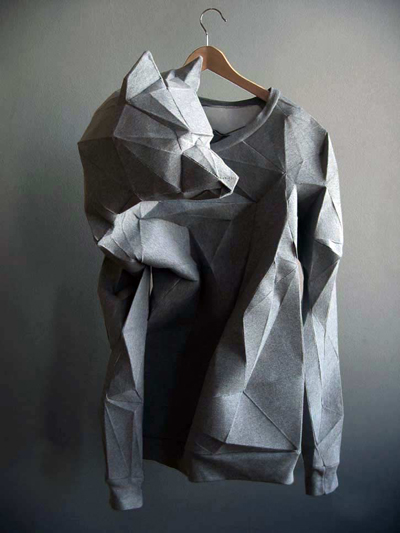
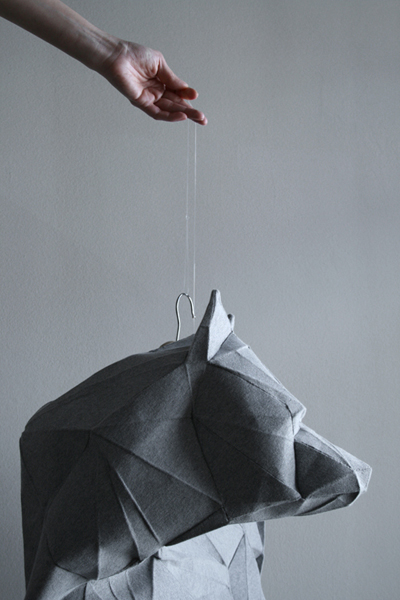
Mashallah Design Linda Kostowski T-SHIRT ISSUE wolf
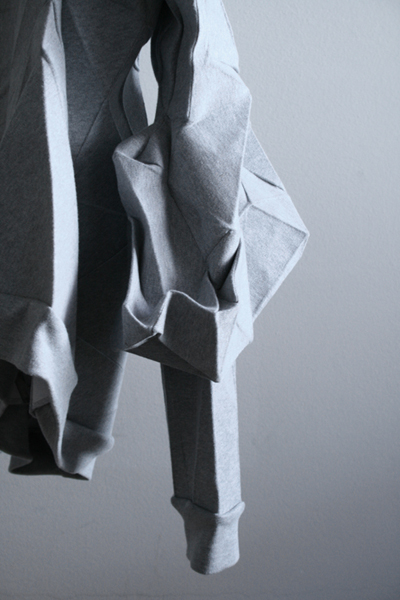
THE T-SHIRT ISSUE is a project by Mashallah Design and Linda Kostowski. A series of three digital portraits in the form of clothing. Their about reads:
Three people are portrayed digitally by scanning their bodies. The output of this scan is a 3d file, which resolution is defined by the amount of polygons, similar to pixels in a bitmap graphic. Linked with their biographical memories a digital twin of the body is thus created, which expands and personifies the garment in a formal-poetic way. The 3d data is turned into 2d sewing patterns by the use of the unfolding function which is a common tool in industrial design process to make paper models with, the single fabric pieces and the inner interface which defines the edges are cut out by the help of a laser cutter.
wolf_1
Making a clothes pattern in this way changes the aesthetics of the garment fundamentally , because in contrary to ordinary pattern construction methods unfolding does not matter about orientations like center front or the shape of a armhole, which frees the designers imagination in a way that feels fresh and liberate. As fabric we used sweatshirt jersey as a reference to the common cliche that Berlin is the city which fashionable output lies in making and painting on t-shirts.
s5
This undoubtedly impressive project has been circling both digital and real world since 2008, has been featured in numerous design blogs - including Yatzer, Dezeen, byAMT and their creator's Mashalla Design own - and has been exhibited in many countries.

So you'd think someone would think twice before they use that quite distinct image of the wolf tee for their advertising campaign, right?

Think again.
PANSIC AD  FAIL Mashallah Design Linda Kostowski T-SHIRT ISSUE
What you see above is a print ad for greek fashion college PANSIK Scuola di Moda.

I feel very strongly about cases like that. However before I got really mad, I tried to cross off all potential explanations that would justify such a choice. Maybe PANSIK actually paid to use that image? Could be the case, but I personally doubt it. It could be poor judgment and lack of professionalism from the graphic designer's side. The quick and easy solution. However, in this particular case, this explanation still doesn't take away the blame from the client.

You see, I believe it is still wrong for a fashion school to promote themselves by using projects of designers irrelevant to that school, even if the images used were actually paid for. Why not use the creations of your own students? Anyone would think you would be eager to show the work they do as part of your classes. Not to mention, it's free! Using a cool image found online is insulting to all your previous and current students, as it's implying they haven't produced anything worthwhile.

Not to mention it's totally misleading to all potential students, who will probably assume this project was made in that particular school.

I've already sent an email to the original artists, informing them of the existence of this ad. Maybe they can clarify things for us. In the meanwhile, whenever you see a case like that, don't let it go unnoticed. It's unfair for both the artist and the public. And you could find yourselves in the place of both.

(the title of this post is inspired by the same-name blog youthoughtwewouldntnotice.com where similar cases of get outed royally by anyone who notices them)

UPDATE: The original artists of THE T-SHIRT ISSUE project answered my e-mail, saying they are totally shocked as they didn´t know anything about this.

Wednesday, 24 June 2009

Designers fight back

The text that follows was published at the Council of Fashion Designers of America official webpage cfda.com. It's quite country-specific (about the Design Piracy Prohibition Act, a bill about to pass in the American Congress. Legally Blonde much?) but do read it, it is extremely interesting.
In 2006, the CFDA took a leadership role in supporting legislature that would protect designers’ intellectual property. President Diane von Furstenberg, as well as several CFDA Members including Joseph Abboud, Jeffrey Banks, Marc Bouwer, Nicole Miller and Zac Posen and Gela Nash-Taylor of JUICY COUTURE, traveled to Washington D.C. to meet with senators to discuss the importance of the issue.

The Design Piracy Probation Act will protect original fashion designs for a period of three years from their registration with the U.S. Copyright Office.
CFDA Executive Director Steven Kolb praised the bill, saying “We are grateful to this influential group of U.S. Senators for recognizing the threat that piracy poses to designers in America today, and we are pleased that they have introduced such a powerful measure to help put an end to it.”

Design Piracy describes the increasingly prevalent practice of enterprises that seek to profit from the invention of others by producing copies of original designs under a different label. These duplicate versions then have the potential to flood the market and devalue the original by their ubiquity, poor quality, or speed at which they reach the consumer. Technological advances to the means of textile and garment production, as well as increases in the number of distribution channels and the availability of cheap labor in emerging economies have created serious challenges to the growth of fashion design in America. The Design Piracy Prohibition Act grew from these concerns, and was initiated with two main objectives: to protect both the established and the up-and-coming designers whose development, growth and success helps to support the $350 billion U.S. fashion industry; and to preserve intellectual property.
For more information on the Design Piracy Prohibition Act, visit www.stopfashionpiracy.com. Be sure to check the amazing video on the top of the page (it is quite long, but totally worth it) and the real vs fake section. Both are real eye-openers.

And to add to the discussion, here is the craft world's point of view, via BurdaStyle:
If this bill is passed, what does this mean for the indie crafting world, as well as the fashion industry as a whole? On one hand, it would ensure that indie designers, who have quite often been victims of intellectual theft by bigger companies are better protected; it would mean that all the hard work gone into designing and creating clothing for sale are not all attempted in vain.

On the other hand, will the bill potentially stifle the creativity of young designers and crafters? Painters and artists often exchange ideas- in the past, this inspired artistic movements. When asked about their favorite fashion designers or influences, fashion students usually have a long list of names they’re able to recite by rote.

How does one specifically pinpoint where design elements come from, or who they’ve truly been inspired by?
I believe I have given you enough food for thought. What do you think? And please, let's try to see this matter as a whole, and leave specific cases out of this. You know who/what I'm talking about...

Monday, 22 June 2009

The Consolagate

Left: Marc by Marc Jacobs. Right: Vasso Consola Collection

It all started with this post by Greek fashion blogger Fashion Paths.

Then came Greek designer Vasso Consola's answer via her facebook.

Allow me to translate:
Usually, we fashion designers don't reply to musings by people who are not in the fashion industry. I'm not sure why exactly that is, probably because we consider our work speaks for itself and that it is not one of our biggest concerns how it will be perceived by someone else. However, when I read this particular comment, I have to say I was bothered, not that I don't accept criticism - that will always be existent when someone works in a profession where criticism is expected and accepted when it's thoroughly thought and good-intended. We can't be agreeable to everyone, we are all different and addressed to different people.
But here, I believe that I detected smart-ass hints and covered meanness, ones that verify the fact that in this country, anyone can be a self-acclaimed anything. Without basic knowledge in Costume History or contemporary fashion, its structures and the way it functions, it seems like Economics should be the subject where this comment's writer can continue to be occupied with, with more accuracy and success.
Nowhere does it state that this is my winter collection. And as far as the fabric is concerned, which seems to be the subject of most similarity accusations, I just want to state what those who are familiar with those things, already know that it is called Pied e coq (sic), it exists as a pattern since the early 1900's and has been used by many designers, in numerous colour combinations. If she [blogger Fashion Paths] was as observative as an actual fashion critic, she would have known that neither the fabric, nor the influences or the concept are the same as my colleague's, Marc Jacobs.
If she knew a few things about me, she would have known that I have my own knitted fabric made for me and that my Atelier Collection clothes are custom made according to each customer's measurements or completely unique (as some of them are created on a dressmaker's form, using the moulage technique, therefore can't be recreated). The ID line is a project connected with the producing process and it's more of a part of my prêt-a-porter line.
In times like this, when you don't even have to buy books to be informed, but instead all information you need can be found online, it's a shame for someone to play fashion journalist, without previously having done some sort of research on the subject they are talking about.
(quick question here: What's with talking in the third person? Isn't she answering to the blogger who "insulted" her? If not, who is this text addressed to? Her "followers"?)

Anyway, here's Fashion Paths' post update after the designer's answer:
By studying economics, I've learned that fashion, via marketing, mainly addresses to the public outside of the fashion industry. A fashion professional may tarnish a designer's name by negatively criticizing him/her. In the end, though, it's the public that judges what is worth buying or not, as its opinion matters the most (the money factor, that is).
Vaso Consola's second facebook answer after that:

Translation:
Someone may be called a "Professional" when they acknowledge their work as something really important and serious. Someone who writes without knowing what they are writing about are not "Professional" even if they have self-proclamed themselves as that. Have a bit of caution girls... One should not buy a laptop and shoot away!
Nice work insulting an entire community, lady.

Sorry if I have tired you with all that back-and-forth answers. I really wanted all the parts of this "conversation" to exist as screenshots and links, and also be translated in English online, so one can form a complete opinion.
For that matter, also read Alecca Rox's post.
That girl tells it as it is.

And other than that, I agree with most of the girls. This matter has left the did she copy or not territory and is now all about why won't she acknowledge fashion bloggers, their presence, their power, and their opinion, not as fashion professionals, but as people who really like fashion, and were admirers and potential clients of hers.

Well, not any more.

Tuesday, 2 June 2009

Deja vu

A few weeks ago, I found myself passing by my neighborhood BADILA store...

...and something on the window caught my eye.

The next day, I was inside the fitting room, alone with two objects of desire and one object of controversy.

The two dresses were quite wonderful...

but the actual objective of my visit was to see the top from the window, up-close.
You see, I had a serious case of deja-vu...

You might remember my beloved Pull & Bear smiley faces scarf. Here's a picture of me wearing it in Venice back in November:

I had originally bought it in October of 2007. I have to admit, I wouldn't remember that information exactly if it wasn't for the tag.

Anyway, here's the pattern of my scarf:

And here's the pattern on the Badila top:

I was quite puzzled, but didn't want to jump into hurried assumptions, so I decided to ask someone who might know how to explain this better than me. Good thing I did, because it turns out this obvious copying of prints couldn't possibly be Badila's fault. You see, Badila is a small Greek business, that simply doesn't produce enough clothes to be able to afford printing its own patterned fabrics. Instead, they get them already printed from fabric factories that cater for clothes companies like Badila, producing new fabrics every season, according to the most popular fashion trends. Well, I guess some lazy designer in that factory thought no-one would notice if he got "inspired" by an old scarf. Guess what pal, we did!

I wonder what is Badila's view on this matter. Would they have chosen this fabric, had they known it was copied from another company's garment? One that sells lots in Greece, nonetheless?